Rose Yard
Before the Second World War (1939-45) a large proportion of Norwich's citizens lived in overcrowded and often insanitary tenements surrounding a small courtyard connected to the main street by a narrow alley or 'passage'. There were hundreds of these ‘yards’, as they were mostly known, all over the city, and at least forty in St Augustine’s parish alone.
Today only a handful can still be identified in the
St Augustine's area, these include Hindes Yard, Nichols Yard, Nunns Yard, Rose Yard, Royal Oak Yard and Wine Cooper’s Arms Yard (all off St Augustines Street), and Dog Yard and Talbot Yard (off Oak Street).
Rose Yard, which once stretched between St Augustines Street and Edward Street, was one of the largest yards in Norwich, with rows of two- and three-storey tenements, a public house, a couple of small shops run from front rooms, a shoe factory, stables, a communal washhouse, and even at one time a Primitive Methodist or "Ranter" chapel: making it more of a street or self-contained community its own right than a yard.
Like many such yards it seems to have been named after an adjacent pub - in this case the Rose Inn, which stood at the junction of St Augustine's Street, Botolph Street and Pitt Street since at least the 14th century. Entrance to Rose Yard from St Augustines Street is still through an archway large enough to allow a horse-drawn coach or brewer's dray to pass through (see illustration right). The pub building is still there but the pub itself, latterly known as the Old Crome, finally closed its doors in 1981. This end of the yard is known as 'the top of the yard', while the now lost end near Edward Street was called 'the back end'. Narrow passages once lead off to smaller yards known as the Back Way.
The north side of the arch (on the right in the above illustration) has been occupied from the 1870s to the present day by a succession of connected business: De Carle's Drug Stores, Coleman and De Carle's opticians and dispensing chemists, and, currently, Coleman's Opticians. The buildings to the rear of the shop were for many years used for the manufacture and bottling of the chemist's own patent cough mixture, Lungene, mineral waters and and powdered fruit drinks.
Rose Yard had a strong community spirit. People helped their neighbours when money was short or there was illness in the family. They also took the opportunity to have fun when they could. Between the wars there were occasional carnivals in the summer (see right), for which the local residents made their own costumes, and Christmas parties in the upstairs room of the Rose Inn. Royal occasions, such as King George V’s Silver Jubilee in 1935 and Victory in Europe in 1945, were also celebrated with street parties and decorated facades up and down the yard.
Slum clearance in the 1950s swept away the tenements and broke up the community that once lived here. In 2012 a run-down children's play area adjacent to the yard was completely renovated by Norwich City Council to provide an attractive place for local kids to play.
Text © Stuart McLaren |
To read an account of living in Rose Yard before the Second World War by someone who grew up there, click the link below:
Living Down the Yard
For more information on Norwich's yards, see:
www.norwich-yards.co.uk/
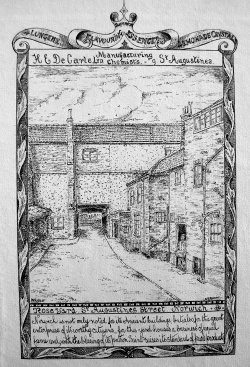
Drawing of Rose Yard featuring the premises of De Carles chemists
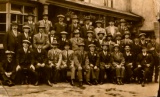
The Rose Inn fishing club
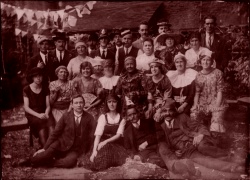
Rose Yard Carnival
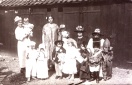
Rose Yard Carnival
| 










.jpg)
