|
Introduction
St Augustine’s is arguably the last parish within Norwich's medieval boundaries to retain a distinctive identity. It is, for example, the only part of the city still commonly referred to by its parish name. The reason for this is partly accidental: the area has long had a marginal identity, cut off by the River Wensum from the main centres of cultural, economic, political and religious activity south of the river; a topographical factor compounded in the latter half of the 20th century by the construction of the inner ring road, which effectively cut off St Augustine's from the rest of the city centre.
The development of St Augustine's unique identity has also been partly deliberate. It forms the northern-most part of an area long regarded as Norwich’s backyard: an area known as Ultra Aquam or Norwich ‘Over-the-Water’. For centuries it has been a place where activities and people found inconvenient or intolerable south of the river have found the space to take root and grow.
'Rus in Urbe' - the Countryside in the City
For more than a thousand years the chief economic activity in St Augustine's was farming; the fertile land here used to grow root crops, fruits and grain, and to graze cattle, horses and sheep. The earliest known settlers here - in the 2nd century AD during the Roman occupation of Britain - are thought to have been farmers. This rural aspect of the area lasted until well into the 19th century when
St Augustine’s was the last parish within the city's medieval boundaries to retain a substantial plot of land in horticulutural use, producing fruit on a commercal basis in nurseries and orchards off Sussex Street. Today, the name of a 1980s housing estate in the parish - The Lathes - links it to the name of a farm worked here from the 15th to the 18th century.
Commercial and Industrial Development
Co-existing alongside its rural aspect, St Augustine's parish has also been home to some of Norwich’s chief trades and industries, including metal working, weaving, dyeing, shoe making and even banking.
In late Saxon times a royal mint was established 'over the water', producing coins for King Aethelstan I. Almost a thousand years later, in 1775, the Quaker brothers John and Henry Gurney, opened the first office of Gurneys Bank here: in Tooley Street (which no longer exists - it was near Cherry Lane) off Pitt Street. The bank they founded is a direct ancestor of Barclays.
While St Augustine's was a hard-working and industrious part of Norwich for several centuries, it has never been a fashionable place to live for the city's well-off citizens, hence the lack of grand dwellings found in other parts of the city. In the 16th and 17th centuries economic migrants and religious refugees from France and the Low Countries, known collectively as the Strangers, found employment and affordable accommodation here. They brought with them innovative weaving, design and dyeing techniques - the 'New Draperies' - which helped revive Norwich's textile trade. The tombs of their well-to-do descendents can be found inside St Augustine's church with names such as De Hague, Castell and Deneaw. During the late 18th century and thoughout much of the 19th century St Augustine's was home to several of Norwich's celebrated silk shawl manufacturers, while in the late 19th century and during the first half of the 20th century it was the shoemaking trade that dominated local industry.
A Place of Refuge for Religious Minorities
A number of religious demoninations and faiths – Baptists, Methodists, Quakers and Jews – have sought refuge in
St Augustine's and neighbouring areas north of the river during periods when the practice of their customs and religions, including the burial of their dead, was deemed unacceptable elsewhere in the city. Norwich's second Friends (Quaker) meeting house and its first Primitive Methodist (Ranter) chapel were opened here in the 17th and 19th centures respectively. Near here may also be found the earliest surviving Quaker and Jewish cemeteries in Norfolk.
Sports and other Revels
For centures St Augustine’s was the favoured locale for those recreations and sports considered too boisterous or hazardous to be engaged in elsewhere in the crowded centre of the city. These included archery and jousting, which were practised here in an area known as the Gildencroft. It seems that also the 17th-century equivalent of "raves" were also held here, forcing the City authorities to order that the immoderate dancing and 'camping' (an early form of football) had to cease as they were spoiling the grass.
Red Steeplers - Then, Now and Yet to Be
Three centuries ago, St Augustine's church with its distinctive red brick tower earned its parishioners the nickname 'Red Steeplers'. Today St Augustine's Community Together Residents' Association is working to promote
St Augustine's as a great place to live, work and play by helping to conserve, cherish and celebrate the area's heritage and by building a safe and sustainable community for future generations of Red Steeplers. |
Links to history pages:
St Augustine's timeline 
Twelve surprising facts
Local history links
St Augustine's church
The Gildencroft
The Quakers
The Jewish Cemetery
St Augustine's School
Rose Yard
Local placenames
Rolls of Honour
Some notable locals
Your memories
If you have stories to tell of life in St Augustine's area we would love to hear them. Please contact us by clicking
the link below
Click here
Click on the images below to view a larger version and for
more information
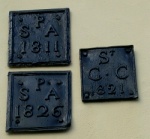
Lead parish boundary markers for
St Augustine's and
St George's Colegate on the side of a building in
Pitt Street
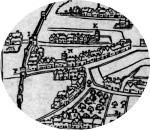
St Augustine's parish as depicted in Cunninghams' Plan of Norwich published
in 1558
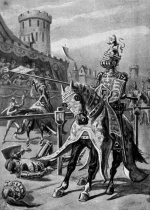
Victorian re-imagining of King Edward III jousting in the Gildencroft on
St Valentine's Day, 1340
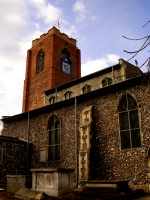
St Augustine's church with its distinctive red brick tower, which gave its parishioners the nickname Red Steeplers
| 











.jpg)
