|
Prehistoric
Very little archaeological evidence of the activities of prehistoric peoples has been found in the area. Among the rare finds are a Stone Age flint arrow head in Aylsham Road, Stone Age or Bronze Age worked flint found in
St Martin's Road and Iron Age pottery found in
St Augustine's Street.
2nd-3rd centuries AD
Fragments of pottery found in the Botolph Street area may indicate a small Roman farmstead was situated here between parallel north-south Roman roads roughly along the lines of present-day Oak Street and Magdalen Street. Other Romano-British finds from the area include a copper oil lamp unearthed near St Augustine's Gate in the mid-18th century, a Roman coin found near Sovereign House in Anglia Square and further fragments of pottery in St Augustine's' Street.
3–4th centuries AD
A Roman coin of this period was found during an exploratory archaeological dig near Anglia Square in 2010.
5–6th century AD
At this period a pre-Christian Saxon cemetery was in use on high ground near present-day Eade Road off Aylsham Road, possibly indicating an established Saxon settlement in the area at this period. Cremation urns and grave goods, including an ornate brooch, were discovered here in 1898 by workmen digging drains. Fragments of pottery of the Middle Saxon period are found in grave fill during exploratory archeaological excavations in the Anglia Square area in 2010.
925–940
The name Northwic (‘North Wick’ - from which Norwich derives its name) first appears on coins of the Saxon king Aethelstan I, indicating they may have been minted in a settlement north of the principal Saxon settlement of Conesford ('King’s Ford'). The present-day St Augustine's and Anglia Square areas are still largely unsettled and covered by a wood known as the Mereholt ('Wood by a Lake') and watered by a stream later called the Dalimund or Dalymond.
940–1065
A defensive ditch is dug along the northern boundary of Northwic (archaeological evidence for this found in the Botolph Street area in the 1970s and again in 2010), but the enemy, when he comes, sails up the river from the east when the army of Danish king, Sweyn Forkbeard, sacks and burns the entire burh (borough) of Northwic in 1004. Four churches may have been established, destroyed and rebuilt in this northern area during this period: St Botolph (in the Anglia Square area, now lost), St Martin-at-Oak and St Mary Coslany (both still in existence) and St Olaf, also known as St Olaves or 'Tooleys' (in the Pitt Street area, also lost). No evidence yet found for a church at this period in the area now occupied by the mainly 15th-century church of St Augustine.
1066–1163
Norman Conquest of England. The Domesday Book, compiled 1085–6, names only six churches in Norwich
(St Augustine’s isn’t one of them ), though there were certainly more.
1163
The earliest known mention of a church in Norwich dedicated to St Augustine in a letter from Prior William de Turbe, bishop of Norwich, to Prior Clement of Llanthony Secunda Priory in Gloucester, confirming the gift of
St Augustine’s church by brother priests Herbertus and Wlfhrac to the priory. The right to appoint priests to have the cure of souls in the parish is thereafter in the hands of the prior of an Augustinian foundation until the early 14th century when it passes to the bishop of Norwich.
1201
Confirmation of appropriation of St Augustine’s church by the prior of Llanthony Secunda, Gloucester, in the records of Norwich cathedral. The prior at this time was probably Geoffrey de Henlow or Henlawe.
1251
The prior of Llanthony Secunda Priory is recognised as the persona (parson) of St Augustine’s church. Prior Geoffrey de Banbury resigned this year and was succeeded by Prior Edward or Everard.
1254
St Augustine’s church is mentioned for the first time in Papal taxation records known as ‘The Valuation of Norwich’, and is rated at 6 shillings and 8 pence per annum (equivalent to less than £200 in today’s value), one of the lowest in Norwich, reflecting this parish’s relative poverty.
1259
John de Grey, bishop of Norwich, confirms the advowson (the right to appoint a priest to a vacant benefice) of St Augustine’s church is in the gift of Prior Bartholomew of Llanthony Secunda Priory, Gloucester.
1268
The earliest known mention of St Augustine’s Gate in a document.
c.1280
A farm known as the Lathes is acquired by the Great Hospital of St Giles in Bishopgate, Norwich. The farm is located somewhere just outside St Augustine's Gate.
1284
The Gildencroft, which partly lay within St Augustine's parish, is acquired by the Great Hospital.
1291-1302
In 1291 Roger, son of Richard de Augustine, is amerced (fined) 6 pence for undermining the city walls, while in 1293 Robert de Readham is amerced 1 shilling for chopping down a tree and carting it away from
St Augustine’s Gate to his own house. Evidence, perhaps, that this area of north Norwich was beginning to be urbanised. There is by this period an established iron smelting trade in Botolph Street area. However, there are still large areas of the parish in agricultural use. At about this time Roger le Quite, a shepherd, buys a messuage (house with land and outbuildings) in the parish, and in 1292–4 John de Birston, a chaplain, is granted land with a barn in the parish.
1303
John de Blickling is appointed rector of St Augustine’s (by the Bishop of Norwich?), the first parish priest for whom we have a name. Evidence perhaps that the parish was growing and now needed a full-time priest and possibly alos for the end of the Augustinian period of the church's history (begun c.1163) when the Prior of Llanthony Secunda Priory in Gloucerster had the right to appoint priests here.
1318
John de Brunham is appointed rector of St Augustine’s.
1325
John Ayleward is appointed rector of St Augustine’s.
1340
King Edward III, Queen Phillippa and their son, Edward, the Black Prince, attend a tournament in Norwich on
St Valentine’s Day. This may have been held in
the Gildencroft, which had a field near the city wall known as the ‘Jousting Acre’.
1342
Richard Spynk completes the fortification of St Augustine’s Gate.
1349
John Hullock (or Hullok) is appointed rector of
St Augustine’s.
1362
A priest known only as ‘Benedict’ is appointed rector of
St Augustine’s.
1370
John Carthowse is appointed rector of St Augustine’s.
1375
Richard Marchal, rector of St Augustine’s, conveys arable land in the parish adjoining the Great Hospital’s farm (the Lathes) to John de Brokenham, a mason. Local property owner, Thomas Spynk, a rich merchant, becomes Bailiff of Norwich.
1381
Peasants’ Revolt: parts of Norwich are sacked and burnt, including, possibly, the old Saxon/Norman church of St Augustine’s.
Late 14th–15th century
Main body of church – nave, chancel and aisles – are completed in late Gothic period, with a mixture of Decorated and Perpendicular styles or architecture, possibly replacing remains of old Saxon/Norman church on the same site.
1418
Sir John Corpusty is appointed rector of St Augustine’s.
1429
A carter employed on the Lathes’ farm in the parish notes in his journal that Saturday 30 April was dedication day at St Augustine’s, possibly indicating re-dedication of the church after recent rebuilding.
1465
Rector Sir John Corpusty dies.
1466
Nicholas Fale is appointed rector of St Augustine’s.
1473
Thomas Gyllyng is buried in the church (its earliest known recorded interment).
1493
John Hodgys is buried in the church.
1499
John Dows (or Dowce) senior, a local worsted weaver, is buried in the church. A brass plaque at the east end of the south chancel aisle (seen by Norwich antiquarian John Kirkpatrick in early 18th century, but now lost) commemorates his interment. His will refers to this area of the church as the Chapel of Our Lady.
1501
Adam Myddylgate appointed rector of St Augustine’s.
1506
Robert Prowett (or Pruet) is appointed rector of
St Augustine’s.
1507
Robert Shirreve, St Augustine’s gate-keeper, is granted rights to farm land between Fybrigge (Magdalen Street Gate) and St Augustine’s Gate, and ordered to keep the ditches of the wall free of cattle and undergrowth.
1510
Norwich Consistory Court has depositions concerning a dispute between the rector of St Augustine's, Robert Pruet, and the rector of the neighbouring parish of
St Clement's over who possessed the right to tithes from the Gildencroft, which was them partly in St Augustine's, St Clement's and St Martin at Oak. The same year Robert Heylesden is appointed the new rector of St Augustine’s.
1513
Elizabeth Smith buried in the church (earliest known recorded interment of a woman in the church).
1515
Reynold Cross buried in the church.
1523
Death of Rector Robert Heylesden. His will mentions the Chapel of St John (possibly in north chancel aisle area, as Lady Chapel was on south side). William Isabelles is appointed the new rector.
1525
William Mylys, a local worsted weaver, dies and leaves £1 (= £380 today) in his will to build new nave roof in the church. A brass plaque is laid in the church to his memory in the north nave aisle. Norwich antiquarian John Kirkpatrick saw it in the early 18th century, but it is now lost. Its inscription, according to Kirkpatrick, included mention of the gift ‘to ye buylding of a new Ruff of ye body of ye Church’.
1531
John Sketur, a carpenter, leaves 4 marks (= about £850 in today’s value) in his will for the church’s new roof, ‘about to be built’.
1538
Robert Curson, a millwright, is buried in the church. His will also leaves a bequest for the new roof.
1540
William Wight appointed priest of St Augustine’s. He is also priest at Rollesby in East Norfolk. He is the last priest to be presented to the living by the Prior of Norwich cathedral.
1544
The Great Hospital of St Giles in Bishopsgate, Norwich, leases the whole of the Lathes farm to Alderman Thomas Codde. It comprises, overall, about 53 acres, including farm buildings, the Gildencroft, a pightle (a small enclosure of land like a paddock), a dove-cote and 30 acres of land outside St Augustine's Gates.
1546
St Olave's church (also known as St Olaf's and Tooley's), is demolished. It had stood on the north side of Cherry lane since at least the 12th century. St Olaf was Viking saint.
1547
£2 (= about £615 in today’s value) is spent on 'mason’s work': new ringing chamber built under the tower and ‘white glass’ placed in the windows in the church. None of St Augustine’s three known bells were cast before this date, so what became of earlier bells? The ringing frame in belfry is for five bells, but only three are known. Church goods are also itemised this year.
1548
St Botolph's church, which stood in the Botolph Street/Anglia Square area from at least the 13th century, is deconsecrated sometime before this date and finally demolished.
1549
Robert Kett’s army of rebels enter Norwich.
St Augustine’s Gate and other property in the parish are set on fire or damaged during the fighting.
1550
Rector William Wight appointed a ‘Commissary’ (deputy priest) of the Bishop of Norwich. The same year William Stamp is appointed rector of St Augustine’s by the Dean and Chapter of Norwich. On 11 May Rector Stamp, a Puritan, leads a group of parishioners in an assault on St Augustine’s high altar, which they smash. He is ordered to repair the damage. Nicholas Ridley, bishop of London had only just ordered the destruction of high altars in the London diocese: but it was not national policy until November. On 14 June John White, a worsted weaver of St Augustine’s, is questioned by the mayor and aldermen of Norwich for ‘prophesying … as hot a summer as was, and as evil and busy a one as the last summer was’, presumably referring to Kett’s rebellion and Stamp’s iconoclasm.
1552–3
St Augustine’s churchwardens are ordered to sell off the church plate and use money raised to repair the church and churchyard, as well as to give to the poor and also to replace church’s remaining stained glass with ‘white’ (i.e. plain, uncoloured) glass.
1553–4
Rector William Stamp is deprived of his benefice and suspended from the clergy for having married Cicely Baxter. Under a new law imposed by Roman Catholic Queen Mary I all priests must be unmarried or if already married renounce their wives.
1558
Queen Elizabeth I succeeds her late sister Queen Mary I. Earliest known graphic representation of St Augustine’s church and parish in William Cunningham’s panoramic plan of Norwich. The church tower is shown behind some buildings, apparently on the wrong side of St Augustine’s Street. The tower is depicted as battlemented and surmounted by a cross, with two rows of windows set two-abreast, in the Norman manner. The church’s baptism, marriage and burial registers date from this year because of new Act ordering the copying of these events into parchment books.
1565
St Augustine’s silver communion cup or chalice bears this year’s date, replacing old plate sold off in 1552/3. St Augustine's plate is now housed in Norwich Cathedral's Treasury.
1566
Adam Tugges appointed rector of St Augustine’s.
1570
On 2 February, Candlemass Day in the Church Calendar (Groundhog Day in the USA) a great flood came to Norwich. St Augustine's was said to be the only city church that escaped damage, presumably because it is on higher ground than any of the other 50 or so churches that existed then ("A church for every week of the year, a pub for every day").
Norwich's City Assembly rules that the churchwardens of St Augustine’s have to have six buckets and a ladder in case of fire in church’s thatched roof (St Peter Mancroft’s churchwardens have to have 30 buckets).
A Census of the Poor finds 65 families in St Augustine's parish in need of poor relief, several are immigrants (called 'Strangers') from the Low Countries.
1590
Death of Rector Tugges. John Staller (also spelled Stoller or Stallor) is appointed rector of St Augustine’s.
1597
Bishop Redman’s Visitation (tour of the Norwich Diocese by church officials) finds St Augustine’s parsonage houses ‘greatlie ruinous and redie to fall downe’. Rector Staller also holds the benefice at Drayton village and resides there. He is criticised by the bishop's commissioners for neglecting his flock. Services in St Augustine’s are mainly conducted by his curate (assistant priest), who rides over from Drayton twice every Sunday. Otherwise the parishioners are left without a priest all week.
1599
Lowestoft-born writer and contemporary of Shakespeare, Thomas Nashe, publishes a prose satire, Lenten Stuffe, which alludes to legend that the ‘Gilding Crosse’ (possibly refering to the Gildencroft) in the parish of St Saviour's in Norwich is the place where red herrings were cured (smoked to make kippers). This spelling is found in early maps too.
1600
Thomas Pye is given permission by the Mayor and his court to build an alms house beside the wall outside
St Augustine’s Gate, which he agrees to give to the City forever.
1617
Richard(us) Bracket is appointed rector of St Augustine’s.
1624–5
Thomas Pye is questioned about having built two houses on top of St Augustine’s Gate without permission of the City authorities. The houses are occupied by Nicholas Cobb and Elizabeth Coates, who agree to pay Norwich Court 4 shilling per annum ground rent (= about £19 in today’s value).
1626
Sir John Suckling leave a bequest in his will for the poor of the parish.
1632
A local rate is raised for mending St Augustine’s well (near east churchyard wall) and making it into a pump by order of the City Court. Householders in the parish are fined for putting thatch or reed roofs on their houses, a practice that had been prohibited by City ordnance as a fire risk. A parishioner is charged for allowing his wife to sleep in the church porch.
1634
Outbreak of bubonic plague in Norwich. Houses of the sick are nailed up in St Augustine’s parish, including that of John Decore. The Rector, Richard Bracket, dies (possibly of the plague?) on 29 December and his remains are interred beneath the chancel. A memorial brass plaque is placed over his tomb (still extant - the sole surviving such brass in the church - but currently not viewable as underneath 20th-century carpetting).
1635
John (or Josephus) Redding appointed rector of
St Augustine’s on 18 June.
1636
John Brend, from a famous Norwich bell-making family, casts a treble bell which is installed in St Augustine’s belfry. Another of the three known bells (undated) was made by William Brend.
1642
Civil war breaks out in England between forces loyal to Charles I and Parliament.
1646
Rector Joseph Reading is dismissed from the living of
St Augustine’s as ‘scandalous’ (possibly for his political and/or religious views and his absenteeism). He is replaced by John Collinges (1623-1691), a puritan preacher and author of religious tracts. Joseph Reading, hearing of this returns to Norwich to try to oust his rival, but on 1 December the Committee of Plundered Ministries orders Collinges to continue as vicar of
St Augustine's and St Saviour's.
1649
A Parliamentary Survey notes the ruinous state of the rectory buildings in the parish.
1650
John Collinges becomes vicar of St Stephen's in Norwich and so may have given up the living at St Augustine's at this time.
1654
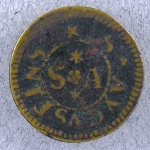
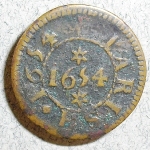
A trade token (a privately issued credit coin) stamped
St Augustines Parish is struck with his date (see right - from a private collection). These tokens were issued by masters to their employees as a form of remuneration when the official coinage was either unavailable or debased.
1660
Restoration of the monarchy.
1662
One John Cooke makes a deposition at the Norwich Diocesan consistory court that the parishioners of St Augustine's take notice that Francis Dye was a whore.
1664
Christopher Stinnett appointed rector of St Augustine’s on 30 November (the rectorship had been vacant for 18 years, but there had been a vicar, John Collinges, from 1646 to 1650). The Revd C. Stinnett is also recror of St Clement's in Norwich.
1668
Death of the rector of St Augustine's, Christoher Stinnett, resigns or retires on 6 July and dies on 9 December.
1670
The Society of Friends (Quakers) purchase an acre of the Gildencroft for use as a burial ground.
1671
The Norwich Bellman (town crier) is ordered to inform ‘the inhabitants beyond the Water that they forbear to spoil the Grass in Gildencroft by immoderate Campings and Dauncings there’. Camping was an early type of football game between two large teams.
1675
Edward Tooke casts a tenor bell for the church.
1676
A Norwich Court orders £25 (= about £2,076 today) spent on repairing the city wall between Magdalen Gates and St Augustine’s Gates. The builder’s final bill comes to £40 (= about £3,220 today). Thomas Bradford is appointed curate of St Augustine's church on 17th February but leaves 3 months later.
1677
St Augustine’s tower collapses; a Mr Nobbs, a school master and clerk at St Gregory’s, notes this in his Chronology of Norwich.
1678
Someone called "Lehum" is rector of St Augustine's in this year.
1682
On 13 May the City Marshals are ordered to apprehend ‘boys and young fellows playing in the Guyldencroft and St Augustine’s churchyard on the Lord’s Day in service and sermon time’. Mr Nobbs (see 1677) notes that the steeple of St Augustine’s church has begun to be rebuilt in July.
1685
Mr Barnard Church leave a bequest in his will for the poor of the parish.
1687
Completion of the new church tower, rebuilt in red brick. The date and a clock are added to the east face.
1688
Rector John Robinson resigns and is possibly replaced by Lynn Smear, possibly for religious reasons. This is the year of the ‘Glorious Revolution’ when Roman Catholic James II is deposed and Protestants William III of Orange and Mary II are proclaimed king and queen by Parliament.
1693
There are approximately 850 people living in
St Augustine's parish at this date, the 12th largest parish population in Norwich.
1697
A silver paten (plate for holding the bread during Holy Communion) is presented to the church by Thomas Harvey, a goldsmith, who was to become mayor of Norwich in 1708.
1698
The Quaker’s new Meeting House in the Gildencroft is completed and opens for meetings for the first time in 1699.
1700
Rector Lynn Smear resigns and Joseph Brett is appointed new rector.
1701
Public execution of Robert Watts outside his house in Botolph Street for the murder of his wife. His last-hour ‘confession’ possibly delivered to the incumbent rector, Joseph Brett (story published in a pamphlet in 1749). The murder becomes a local legend and ghost story.
1703
Rector Brett preaches a sermon in the cathedral to mark the anniversary of Queen Anne’s succession to the throne.
1705–6
Date of St Augustine's church’s silver flagon.
1713
Norwich historian John Kirkpatrick visits St Augustine’s and sketches the church.
1720
John Gurney, a Quaker known as the ‘Weavers’ Friend’, defends Norwich weavers before Parliamentary Committee, resulting in the banning of the wearing of garments made from foreign calico (white, unbleached cotton) imports from India, which helps save
St Augustine’s weavers from ruin.
1721
12 May - The marriage of Matthew Brettingham, freeman bricklayer, and Martha Bunn, spinster of the parish, in
St Augustine's church.
1726
The church's south porch and chancel roof rebuilt and the date added to porch and ceiling (now lost). The earliest dated memorial in the porch is from 1730.
1729
The Revd Thomas Ottway is appointed rector of
St Augustines' on 20 December.
1733
The Revd Thomas Ottway dies. The Revd John Brooke is appointed rector of St Augustine's. The Revd Lemman is curate during some of the Revd Brooke's long incumbency (i.e. 57 years - see 1790).
1751
The City Corporation leases land adjacent to the church, part of a farm known as the Lathes, to the architect Matthew Brettingham the elder. He has his gardens here, and he sets man traps in them after he is robbed of the stakes he had erected to support his espaliers (fruit trees trained onto wooden stakes).
1752
Following riots at Methodist meetings in Norwich instigated by the Hell Fire Club, the Non-Conformist preacher James Wheatley shelters in Henry Jermyn’s house in St Augustine’s where two garrets (attic rooms) are used for ‘conventicles’ (religious meetings outside the established Church). There are 1,226 people living in
St Augustine's parish at this date, dwelling in 266 houses, an average of 4.6 persons per dwelling.
1756
Methodist preacher James Wheatley is found guilty of immorality with a series of young women and misappropriation of funds. John Wesley describes him in a letter as a 'wonderful self-deceiver and hypocrite' who had shown 'obstinante wickedness' in his relationships with women. Wheatley appeals against his conviction twice and having lost both temporarily turns from preaching to the practice of ‘physick’. He later returns to preaching under the protection of Lady Huntingdon.
1759
Mr Edward King leaves a bequest in his will for charitable purposes in the parish
1769
The architect Matthew Brettingham the elder (born 1699) dies in or close to the parish of St Augustine's and is buried in a vault beneath St Augustine's church's north chancel aisle. A memorial is later erected in above the vault. The son of a bricklayer and a freeman bricklayer himself, Brettingham worked on Holkham Hall in north Norfolk and other grand houses and civic buildings in East Anglia, London and Derbyshire. He had rented a garden in St Augustine’s (see 1751).
1775
The first Gurney Bank (one of the ancestors of Barclays Bank) opens for business in St Augustine’s parish (in the now lost Tooley’s Street off Pitt Street) on 13 May. Its Quaker directors John and Henry Gurney are sons of John Gurney, the ‘Weavers’ Friend’ (see 1720). The bank is managed by Simon Martin, another Quaker.
1777
John Hunt, possibly the son of a St Augustine’s weaver, is baptised at St Clement’s; he becomes a teacher, printer, ornithologist and artist. He is author and artist of British Ornithology (published in 3 volumes Norwich between 1815 and 1822).
1779
Gurney’s Bank relocates from Pitt Street to Redwell Plain in the parish of St Michael-at-Plea.
1790
Death of the Revd John Brooke, rector of St Augustine's for 57 years. The Revd Peter Hansell is appointed rector of St Augustine’s.
1794
St Augustine’s Gate is demolished.
1795
The Revd Charles John Smyth is appointed rector of St Augustine's. Smyth published a number of pamphlets on various subjects, mainly copies of his sermons on religious controversies such as the 'conversion' of the Jews, Roman Catholicism and Evangelicalism, but also an essay on the science of acoustics and Six Letters on Singing, from a Father to his Son (published 1817), which included the following piece of advice: ‘When you are singing, stand erect; hold your head high; do not tuck your chin into your cravat’.
1798
On 4 February Miss Elizabeth Gurney (who later become Mrs Elizabeth Fry, the prisoner reformer), hears William Savery, a Quaker preacher from Philadelphia, speak at the Friends Meeting House in Goat lane in the morning and at the Gildencroft Meeting House later in the day. In her memoirs she marked the impression made by Savery's words as the true beginning of her religious life.
1801
Norwich painter John Crome sets up a school of art in
St Augustine's parish at 17 Gildencroft, Norwich.
1803
Norwich painter Obadiah Short is born in St Augustine's parish on 26 July
1813
Norwich’s Jewish community lease a plot of land in the Gildencroft for use as a cemetery.
1818
Thomas Jones is appointed stipendairy curate of
St Augustine's church on 24 May.
1820-1
Date of St Augustine's church’s silver strainer spoon.
1821
Robert Jay is appointed stipendiary curate of
St Augustine's church on 14 October.
Mr Samuel Chapman grants the proceeds and rents derived from a deed to a property in Hellesdon (15 acres and cottage) for charitable purposes in the parish.
1824
The Revd Jon. Chase Matchett is appointed rector of
St Augustine's.
1826
Henry Lewin is appointed curate of St Augustine's church on 18 June.
1828
Martin Baylie Darby is appointed stipendiary curate of
St Augustine's church on 8 June.
1830
Unemployed weavers attack looms at William Springhall’s house in St Augustine’s parish during the 'Captain Swing' disturbances: a pistol is discharged wounding Springhall. One of the ringleaders, Richard Nockolds, is later hanged for rick-burning.
1832
The Revd Samuel Stone is appointed rector of
St Augustine's.
1838
St Augustine’s District School established on land outside old gate area by William Geary.
Mr Edward Manning makes a gift in perpetuity of an annual dole of blankets for the benefit of the poor of the parish.
1842
The Revd Samuel Stone, rector of St Augustine’s, publishes ‘A few parting words to the parishioners of
St Augustine’s, Norwich’, exhorting his parishioners to observe the Sabbath because church attendance is declining. The Revd John Beckwith is appointed rector of
St Augustine's.
1848
The Revd Matthew John Rackham is appointed rector of
St Augustine's.
1851
A census of religious worship for Norfolk records attendance at St Augustine's church on one Sunday in March as 100 at the morning service plus 30 Sunday school scholars, and 127 at the afternoon service plus 53 Sunday school scholars. The average number attending in the afternoon is said to be about 200. Figures provided by the rector, the Revd Rackham.
1853
The Norwich-born poet, dramatist and novelist Amelia Opie (born 1769), known in her youth as ‘the belle of Norwich’, dies and is buried in the Gildencroft Quaker burial ground.
1858
Thomas Clabburn, a local silk manufacturer, dies and a memorial tablet is erected in the nave of St Augustine's church by 600 of his weavers.
1874
The vestry is moved to under the church tower.
St Augustine’s churchwardens William Gilbert and William Delph are ordered to restore the churchyard's original boundary after road widdening works in
St Augustine's Street encroaches on the churchyard.
1875
Churchwarden William Thomas Gilbert is briefly imprisoned in Norwich Gaol by the Consistory Court of the Archdeacon of Norwich for refusing his order to mark out the original church boundary with stone markers after road widening had encroached on the churchyard.
1877
The Revd William Alexander Elder (b.1823) is appointed rector of St Augustine's. Prior to becoming rector he had worked as a missionary for about 14 years, first in Newfoundland and then in Natal. At this date the old clock in the tower is declared to be derelict and the church fabric is found to be genearally in a bad state of repair both inside and out.
1878
The Revd Elder institutes a Church Restoration Fund.
In November a great flood inundates low-lying areas of Norwich, including Pitt Street, St Martin's Lane, St Mary's Plain and Jenkin's Lane. For a while, Sussex Street and the Gildencroft are the only streets passable on foot.
1879–80
Restoration work on St Augustine's church is undertaken by the diocesan surveyor of ecclesiastical dilapidations, Richard Malikwaine Phipson (died 1885). His plans to re-seat the church with pitch pine pews, build a new bell ringing floor under the tower arch and renew the chancel roof but funds run out.
1884
One Thomas Lord, a self-appointed assessor of Norwich's various places of worship, visits St Augustine's church one Sunday. He describes the form of worship here as 'Low', with music supplied by 'unsurplised' boys and a harmonium. The Revd Elder's sermon he found 'thoroughly evangelical and in earnest'.
1892
The Gildencroft Recreation Ground is purchased by the City Corporation for £2,700 and opened by the mayor, it is one of the first public open spaces in Norwich.
1894
St Augustine's churchyard is converted to a public garden and resting-place by the City Corporation. At the ceremony the mayor opens the garden while a band plays. An additional part of the Gildencroft is also opened to the public by the mayor as a place of recreation.
1898
April - Workmen digging drains in Eade Road off Aylsham Road discover what turns out to be an early, pre-Christian Saxon cemetery, with cremation urns, an ornate bronze brooch, tweezers and other grave goods.
1899
Restoration work on St Augustine's church, left off in the early 1880s through lack of funds, is restarted. New stained glass is installed in the central east window (depicting Christ Teaching – the gift of Mr R. Foulsham Ladell) plus a new reredos behind the altar (Mr F. M. Hotblack’s gift). Cement rendering is removed from outer walls of the church and restoration work is done on the south porch and new drains are dug.
1900
The Revd Herbert Webster is appointed rector of
St Augustine's.
1902
A stained glass window is installed in the north chancel aisle of St Augustine's church depicting St Augustine of Canterbury and St Felix of Dunwich, regarded as the first Christian evangelisers of England and East Anglia, respectively.
1906
The Revd John Herbert Griffiths is appointed rector of
St Augustine's. The church organ, originally built for
St Peter Hungate's church in Norwich, where worship had ceased in 1902 because the building had become derelict, is re-erected in St Augustine’s church. Its position partly obscures the new stained glass window in the north chancel aisle (see 1902).
1914
Outbreak of First World War. Many men from the parish enlist or are mobilised from the Reserves.
1915
St Augustine's Parochial Church Council buys plot of land adjacent to the churchyard from Norwich Grammar School on which to build a new parish hall ands Sunday school. Construction begins under supervision of Churchwarden, Harry Greengrass's building firm. Minns Buildings (three labourers' cottages) on the site demolished.
1917
The Great War continues to take its toll of local men. Private John Henry Abigail of the 8th Battalion Norfolk Regiment, is shot for desertion in France, the only member of the regiment to be so executed during the First World War (see 2006). His parents lived in Distillery Yard off Oak Street in the parish of St Mary Coslany, which is united with St Augustine’s at this time. Despite the perceived dishonour of his death his name is later included in the combined parishes’ Great War Roll of Honour.
1920
Oak screen roll of honour, paid for by St Augustine’s and St Mary Coslany’s ‘working-class parishioners’, is erected in the church to the memory of 79 men from the two parishes who died on active service or of their wounds or illness shortly after discharge in the period 1914 to 1919.
1927
A new electric clock, built by Gents of Norwich, is installed in St Augustine's church tower.
1928
The Revd Frederick Andrew Hannam is appointed rector of St Augustine's.
1933
The Revd Christopher Harold Flack is appointed rector of St Augustine's.
1942
At the end of April many buildings in the parish and nearby areas are damaged or destroyed by enemy bombing during the so-called ‘Baedeker Blitz’ on Norwich, including the 17th-century Friends' (Quaker) Meeting House in the Gildencroft, St Augustine’s School and St Mary’s Baptist Chapel in St Mary's Plain. St Augustine’s 15th-century church escapes undamaged.
1943–7
No rector is appointed during this period.
1947
The Revd Percy Smith is appointed rector of St Augustine's.
1949
27 February. A service of thanksgiving and dedication is held in St Augustine's church to commorate the restoration of the church.
1953
The Revd Noel Henderson is appointed rector of St Augustine's.
1956
The Gildencroft’s row of 14 Tudor cottages is renovated and converted to six houses, but three are demolished by the Council near the Pitt Street end in order to widen the road. The road is not widened!
1957
The Revd MacDonald Steele is appointed rector (the last rector of St Augustine’s; the end of a 650-year-old tradition).
1958
Dedication of Processional Cross, Easter Day 6 April, by the Revd MacDonald Steele, presented by William Albert Barker in memory of his wife Eva.
1960
Restoration work on the organ is undertaken by the firm of Hill, Norman and Beard, who install three stops taken from the derelict Bevington organ in the nearby church of St Mary's Coslany.
1968
The Revd Idris Jones is appointed priest-in-charge (vicar) of St Augustine's.
1973
Archaeological excavations in Botolph Street uncover evidence of 11th-century domestic occupation.
1974
Further archaeological excavations in Botolph Street uncover a late Saxon ditch north of the street, possibly part of the burh's defenses against Danish incursions in the 10th century.
1975
The Revd Jack McGinley is appointed priest-in-charge (vicar) of St Augustine's.
1976
The Revd Roy Skelhorn is appointed priest-in-charge (vicar) of St Augustine's.
1979
The Revd Laurence Hubbard is appointed priest-in-charge (vicar) of St Augustine's.
1985
The Revd Anthony P. Ward is appointed priest-in-charge (vicar) of St Augustine's.
1996
St Augustine’s church's three 17th-century bells are removed when there is concern about the structural stability of the tower. They are donated to All Saints’ church, Carleton Rode, in south Norfolk, where they make up a six-bell peal.
2000
The care and ownership of St Augustine’s church building is transferred from the Church Commissioners to the Churches Conservation Trust.
2001
The Revd Nicholas Vesey is appointed vicar of the parishes of St Augustine’s and St Luke’s in New Catton.
2002
On 16 June the first Holy Communion service is held in
St Augustine's church following completion of conservation work undertaken on behalf of the Churches Conservation Trust. Later in the year, City Works begins work onthe renovation of the churchyard, mending paths, walls, etc.
2003
On 16 October a meeting is held in St Augustine's Hall. It leads to the establishment of St Augustine’s Community Together Residents’ Association (SACTRA) in 2004, a new campaigning community action group dedicated to tackling anti-social behaviour and social and environmental issues in the St Augustine’s area.
2004
In August the first St Augustine’s summer garden party is held. A brick column carved by artist Gary Breeze is placed at the new Pitt Street entrance to the Gildencroft Park to celebrate the historical associations of the Gildencroft with jousting and other sports.
2005
In August the Lord Mayor of Norwich, Cllr Mike Banham, opens the second annual St Augustine’s summer Garden Party.
2006
13 August - Children’s Carnival Day and St Augustine’s History exhibition opens. In November, Private John Henry Abigail of the 8th Battalion Norfolk Regiment, who was shot for desertion in France in September 1917 and is listed on the St Augustine's Great War Roll of Honour, receives a pardon from H.M.Government together with 303 other executed British servicemen of the First World War.
2007
1 June - Launch of the St Augustine’s Community Together Residents' Association (SACTRA) website.
2008
27 July - St Augustine's Medieval Fair is held in
St Augustine's churchyard and hall.
15 October - St Augustine's Community Together Residents' Association celebrates the 5th anniversary of its first meeting.
2010
St Augustine's one-way, gyratory road system is constructed. A brick column carved by artist Charlotte Howarth is placed at the junction of Pitt Street and St Augustine's Street, celebrating the area's association with the textile trade. The Spread Eagle pub in Sussex Street finally closes after around 180 years trading and is converted into a private residential dwelling.
2012
June: "The STAGE" (St Augustine's Gateway Enterprise), a new community resource, is opened at 52 St Augustine's Street. A former shoe factory, Clarkes Shoes, latterly used as an office by Norwich Union (AVIVA), is demolished in Sussex Street and work begins on building 19 new houses on the site to be known as Quintain Mews (completed in 2013).
2014
January: St Augustine's Community Together Residents' Association (ACT) celebrated its 10th birthday with a meal at St Augustine's Hall.
October: The vicar of St Augustine's and St Luke's, the Rev'd Nicholas Ivo Vesey, celebrates his last mass in the parish prior to departing to a new ministry role in Aspen, Colorado, USA.
2015
January: new zebra crossing installed on St Augustine's Street.
13 February. Dinner at St Augustine's Memorial Hall to celebrate the centenary of the Hall's founding, attended by His Worship, The Sheriff of Norwich, William Armstrong OBE.
27 June: new vicar of St Augustine's & St Luke's is instituted: the Rev'd David Austin.
2018
12 July. New Priest-in-charge of St Augustine's and St Luke's, the Rev'd Sarah Quantrill, is installed.
St Augustine's Timeline © S. J. McLaren |
|
|
|
|












.jpg)
